
Hungary – Nato’s Fifth Column
Orban’s spies accused of selling military secrets to Putin

A leading government politician has admitted that Hungary is in Russia’s thrall because of the “cheap gas” it receives from Moscow, confirming the suspicions of Nato allies that Budapest can no longer be trusted.
The admission by Janos Lazar, the transport minister who is seen as a potential successor to Viktor Orban, comes after Ukraine caught two Hungarian spies gathering intelligence at military bases that could only be of use to Russia. Orban’s government is currently running an increasingly xenophobic referendum against Ukraine’s EU membership.
Lazar was speaking this week at a public meeting in the village of Nagykallo near the Ukrainian border when he gave his government’s most accurate, if somewhat florid, assessment yet of Hungarian-Russian relations. “No one likes Russians in this country,” he began as the rowdy audience fell silent.
“We do not have good relations with the Russians because we lick their arses or love them. We have good relations with the Russians because they give us cheap gas,” Lazar said. His speech was first reported by the independent Telex news site.
Since the invasion of Ukraine in 2022, good relations with Russians have meant blocking or threatening to block EU sanctions against the Kremlin, refusing weapons deliveries to Kyiv, delaying Sweden’s accession to Nato and attempting to thwart the appointment of Mark Rutte as Nato Secretary General. Daily government propaganda and top officials blame Ukraine for the war and portray Russia as a champion of peace.
Nato has already begun restricting access to Hungarian officials in the light of Orban’s cozy relations with Vladimir Putin. Recent revelations about the activities of an alleged Hungarian spy ring operating in Ukraine have raised the alarming possibility that Hungary is acting as a fifth column within the Western alliance, selling secrets to the Kremlin.
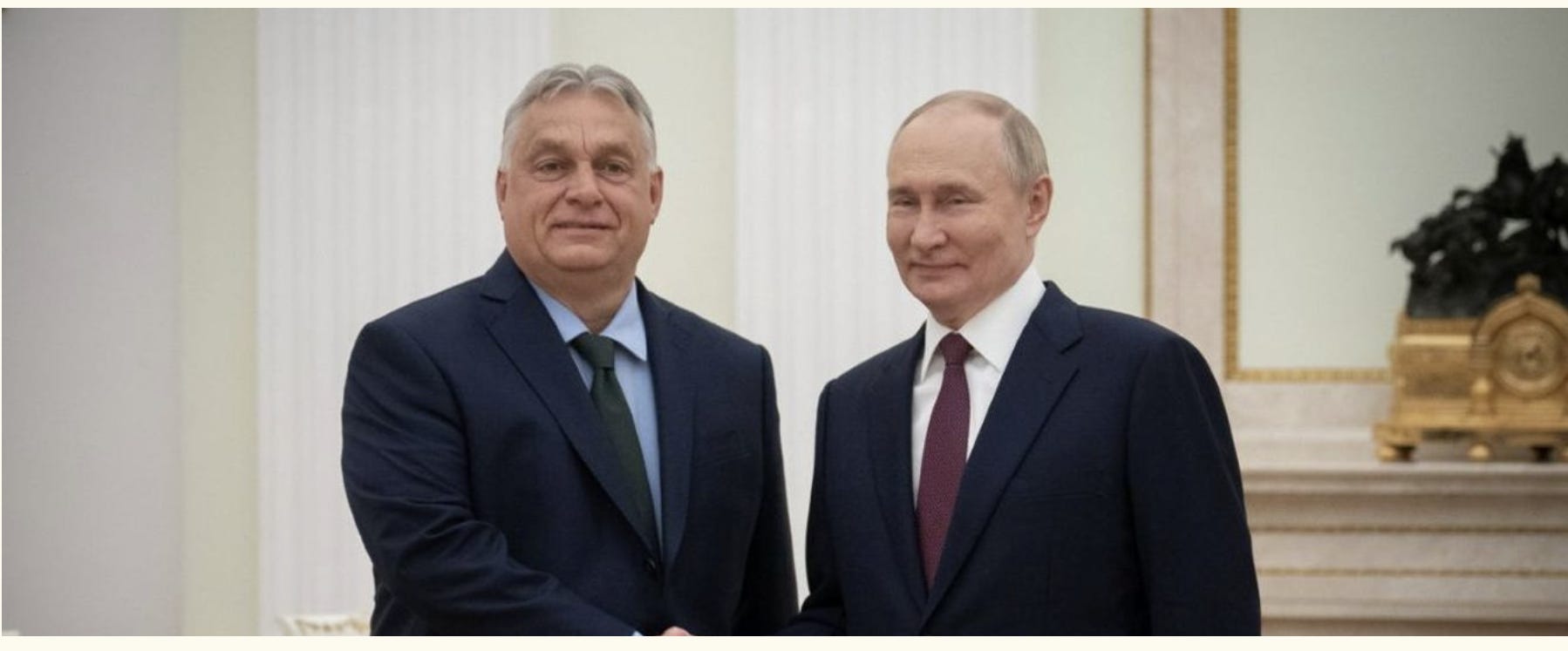
Hungarian officials working at Nato headquarters in Brussels are privy to information that would be extremely useful to Russia: specifications of the latest British, French or German weaponry; deployment of forces and equipment now or in a future conflict; precise location of pipelines and those undersea cables beloved by Russian ships; planned response to an attack on a member of the alliance, such as Estonia.
Western embassies report that links between comrades in Budapest and Moscow are almost as fraternal as in the days of the Warsaw Pact, some blossoming into personal business ties that go far beyond cheap gas.
The Hungarian Defence Minister, Kristof Szalay-Bobrovniczky, made his millions running a joint Hungarian-Russian company that manufactures train carriages and supplies the defence industry. He passed the company into friendly hands when he was appointed to his current job in 2022. He began his stint at the ministry by purging pro-Western officers. His wife Alexandra Szentkiralyi, a failed contender for Mayor of Budapest, has been pumping out some of the most lurid anti-Ukraine propaganda in recent days. One video suggests Hungarians will all be tied up and thrown into car boots by Ukrainian mafiosi if their country is allowed into the EU.
The Hungarian foreign minister, Peter Szijjarto, has made more than a dozen visits to Moscow. In December 2021 he was awarded the Order of Merit for Friendship, the highest Russian honour that can be bestowed on a foreigner.
Antal Rogan, Orban’s cabinet chief who oversees the domestic intelligence services, ran and profited from a cash-for-passports scheme that let thousands of Russians and Chinese into the EU. The US Treasury put Rogan on its sanctions list for corruption, but the Trump administration took him off this year.
Many Orban-linked oligarchs continue to cultivate thriving business interests in Russia. Some have been caught smuggling Western sanctioned goods to Russia with potential military applications.
Russia’s embassy in Budapest has the highest number of diplomats – ie spies – in the EU. For years the Hungarian authorities turned a blind eye to a bank that was a well-known front for the FSB. The International Investment Bank, headed by FSB officer Nikolay Kosov, had moved from Moscow to the Hungarian capital in 2019. Only when it was put on a US sanctions list in 2023 did its Russian owners decide that it was time to return home.
Hungary’s friendly ties to the Kremlin were brought into sharp focus in May when the Ukrainian authorities announced that they had arrested two residents in the Transcarpathia region and charged them with spying for the KNBSZ, Hungary’s military intelligence service. In an interview with the independent Hungarian news site Valasz Online this month, Zelensky said he had checked with Nato officials, who told him the agents were not working for the Western alliance.
“Why was it necessary to look for our vulnerabilities in the Ukrainian-Hungarian border region?” – Zelensky asked. “Why did the Hungarians want information about where we had deployed the S-300 air defence missile system?…And where our various military units are stationed.”
The Hungarian government did not deny the allegation, though it retaliated to the arrests by expelling a Ukrainian and detaining a suspected spy. A charitable explanation would be that Budapest was looking into the logistics of sending peace-keepers into a region inhabited by about 70,000 ethnic Hungarians in the event of a ceasefire or a collapse of the government in Kyiv. However, the easiest and quickest way for those troops to get there would be by road. Why would Ukraine’s air defence batteries be of interest to Hungary?
It seems to make little sense why Hungary would choose Russia over its Western friends and allies, yet all the indications are that Orban has placed himself at the side of despots. Still, it is almost unthinkable that one member state would sell out the rest of Nato to the Russians - surely as unlikely as a Nato member probing weaknesses in Ukraine’s air defence. But not impossible, and Nato will have to take further precautions.
The alliance would need US approval to suspend Hungary’s membership. That will not happen while Donald Trump is president, so Nato will just have to find other ways to keep Budapest out of the loop. At an EU summit in December 2023, Orban was threatening to veto the first stage of Ukraine’s application. “Leave the room and grab a coffee,” he was told by one of the grown-ups (Olaf Scholz). And so he did, and Ukraine took one step towards Europe.
It is quite likely that Hungarian officials will be sipping a lot of coffee alone at future Nato meetings.
And a treadmill🤣
Time to give Orban a coffee machine :)